
VERB TO BE
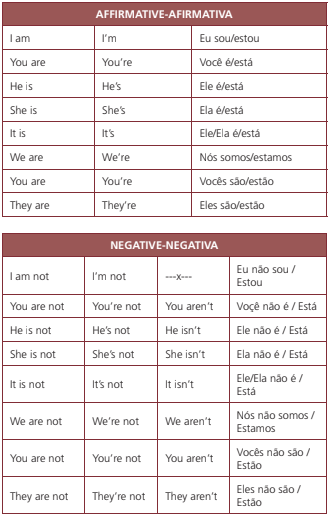
O verbo to be equivale aos verbos ser e/ou estar em português.
A conjugação do verbo to be no presente simples (simple present) é:


VERBOS THERE IS, THERE ARE
Os verbos There is, There are estão no tempo presente e equivalem ao verbo haver no sentido de existir em português. There is é usado antes de coisas ou pessoas no singular, e there are é usado antes de coisas ou pessoas no plural.
As formas dos verbos there is e there are são:

Exemplo:
There is much information on TV.
There are many students in that school.
There isn’t any car in the garage.
There aren’t many people in the stadium.
Is there much sugar in the pot?
Are there three rooms in that house?
VERBOS NO PRESENT CONTINUOUS/ PROGRESSIVE
O Present Continuous ou Progressive indica uma ação que está em progresso no momento da fala. Também pode indicar ações temporárias no presente, ações futuras e acontecimentos que parecem
infindáveis no presente (hábitos irritantes).
A conjugação do “Present Continuous” é:

FORMAÇÃO DO PRESENT CONTINUOUS OU PROGRESSIVE

I. Ação ocorre no momento em que se fala
Exemplos:
What are you doing now? I’m xing my father’s car.
Listen!, Somebody is knocking at the door.
What is that music you’re playing?
II. Ação temporária que ocorre num período de tempo no presente, mas não necessariamente no momento em que se fala
Exemplos:
Paul is reading a book of Jorge Amado.
The U-2 is performing at Maracanã.
People are eating less meat nowadays.
III. Indicar uma ação futura
Exemplos:
Hurry up! The plane is leaving soon.
She is visiting her mother in Niterói tomorrow.
I’m on vacation at the moment, but I’m starting a new course next week.
Descreve e enfatiza uma série de acontecimentos infindáveis.
Nesse tipo de ação geralmente usamos advérbios como “always, forever or constantly” e outros advérbios de frequência.
Exemplos:
She’s always trying to show that she knows more than everyone else.
I’m constantly having to remind you to tidy up your things.
Formação do sufixo “ing” com alguns verbos:
• Verbos de uma só sílaba, terminados por consoante precedida de uma única vogal, dobram essa consoante para o acréscimo
de –ing:
beg → begging
hit → hitting
stop → stopping
• Verbos terminados em –e perdem o –e para o acréscimo de –ing:
bake → baking
love → loving
rise → rising
• Verbos terminados em –ee conservam essa terminação para
o acréscimo de –ing:
agree → agreeing
ee → eeing
see → seeing
• Verbos terminados em –ie perdem essa terminação e recebem –y antes da colocação de –ing:
die → dying
lie → lying
tie → tying
dye (tingir) → dyeing
• Qualquer verbo terminado em –y é simplesmente acrescido de –ing:
obey → obeying
study → studying
play → playing
cry → crying
• Verbos terminados em –l precedido de uma única vogal dobram essa consoante para o acréscimo de –ing; quando o –l for precedido de duas vogais, a duplicação não é efetuada:
label → labelling
steal → stealing
feel → feeling
• Verbos com mais de uma sílaba, terminados por consoante precedida de apenas uma vogal, dobram essa consoante, se o acento tônico recair na segunda sílaba; se não, apenas recebem –ing:
begin → beginning
permit → permitting
master → mastering
open → opening
TEXT COMPREHENSION
TEXT 1
By the end of the first quarter of the nineteenth century a number of our Eastern institution – Harvard, Yale, Columbia, and Pennsylvania had some of the necessary ingredients of a university, but hardly yet the point of view. They were little clusters of schools and institutes. Indeed, just after the Revolution, the schools of Pennsylvania and Harvard had assumed the somewhat pretentious title of university, and, shortly after, the University of Virginia was founded under the guidance of Thomas Jefferson. In the South, Georgia and later North Carolina began to rise. The substance in all these was mainly lacking
though the title was honored. There were rather feeble law medical and divinity schools, somewhat loosely attached to these colleges. It has been commonly recognized, however, that the rst decade after
the close of the Civil War, that is, from about 1866 to 1876, was the great early owering of university idea in America.
- (IME) In the opinion of the author of this passage, in 1825
a) only Harvard, Yale, Columbia and Pennsylvania could truly be called universities.
b) all American educational institutions could justi ably claim to be universities.
c) those institutions which called themselves universities were not justi ed in doing so.
d) those institutions which called themselves universities were justi ed in doing so.
e) no American institution of higher education had any of necessary ingredients of a university. - (IME) Thomas Jefferson founded
a) the University of Pennsylvania.
b) Harvard.
c) the University of Virginia.
d) the University of Georgia.
e) the University of North Carolina. - (IME) The Civil War ended
a) about 1866.
b) about 1876.
c) about 1856.
d) during the decade from 1966 to 1876.
e) exactly in 1876. - (IME) The University idea really began to develop
- a) in the rst quarter of the nineteenth century.
- b) just after the Revolution.
- c) during the last quarter of the nineteenth century.
- d) just after the Civil War.
- e) just before the Civil War
TEXT 2
“Second Wind – This is a feeling of relief that occurs after exercise has become strenuous. Whereas breathing was labored and the work felt painful before, breathing becomes easier and the work more tolerable after athletes experience a second wind. The reasons for this reduction in effort are not known. The early distress may be associated with the temporary use of anaerobic metabolism until oxygen consumption has increased and aerobic metabolism is providing a larger percentage of the energy for work. There is some support for this notion in the fact that second wind only occurs during endurance efforts. Second wind usually occurs when athletes are just beginning their training program after a long layoff. Well-trained athletes rarely experience this phenomenon, probably because their circulatory system adjust more rapidly after they become conditioned.”
(“Swimming even faster”, Ernest Maglisho)
- (AFA) According to the excerpt, second wind is _.
a) a painful exercise
b) a good sensation
c) an exercise training
d) the aerobic metabolism - (AFA) When does second wind happen?
a) During endurance efforts
b) In the beginning of a layoff
c) When athletes reduce efforts
d) When doing anaerobic exercises - (AFA) __ do not feel second wind often.
a) Athletes who have a good preparation
b) Athletes who have strenuous breathing
c) Athletes who have increased the use of anaerobic consumption
d) Athletes who have a good experience with this kind of phenomenom