
FORMAÇÃO DOS SUBSTANTIVOS
Os substantivos são utilizados para identificar ou dar nome as pessoas, coisas e qualidades que nos circundam.
Exemplos:
student, man, house, sky, Monday, France, hope, information.
Substantivos com sufixos que formam algumas profissões:
• R
Exemplos:
baker, builder, designer ,manger, speaker, teacher
• ER
Exemplos:
engineer, footballer, gardener, lawyer, photographer, trumpeter, butcher, carpenter, grocer, plumber, usher
• OR
Exemplos:
actor, author, director, doctor, editor, professor, solicitor, surveyor, tailor
• IST
Exemplos:
cellist, pianist, violinist, geologist, physicist, economist, scientist, chemist, artist
• IAN
Exemplos:
mathematician, musician, politician, statistician, historian, librarian, technician
• ANT
Exemplos:
accountant, assistant, attendant, consultant, informant, inhabitant
• ENT
Exemplos:
resident, superintendent
Alguns sufixos formam substantivos abstratos:
• TION
Exemplos:
information, situation, solution, de nition, promotion
• SION
Exemplos:
explosion, persuasion, invasion, conclusion, decision, conversion, recession
• MENT
Exemplos:
amusement, judgment, excitement, argument, statement, arrangement
• NESS
Exemplos:
sadness, readiness, usefulness, redness, business
• ANCE – ENCE – ANCY – ENCY
Exemplos:
independence, attendance, accountancy, ef ciency, nuisance, emergency, conscience
• ABILITY – IBILITY
Exemplos:
probability, respectability, possibility, responsibility
• ISM
Exemplos:
classicism, communism, realism, liberalism, socialism, romanticism Outros su xos que também forma substantivos.
• AL
Exemplos:
arrival, committal, denial, dismissal, proposal, refusal, withdrawal
• DOM
Exemplos:
kingdom, wisdom, random, condom
• HOOD
Exemplos:
likelihood, neighborhood, childhood, fairhood
• TH
Exemplos:
breadth, depth, length, width
GENDER OF NOUNS (GÊNERO DOS SUBSTANTIVOS)
Em alguns casos, o feminino em inglês é formado a partir da adição do sufixo -ESS ao substantivo masculino.

Alguns substantivos masculinos apresentam formas irregulares de feminino.

Alguns substantivos apresentam apenas uma forma, tanto para o masculino quanto para o feminino.

Para distinguir o gênero dos substantivos que designam a maioria das espécies de animais utilizam-se as formas male (macho) e female (fêmea).

THE PLURAL OF NOUNS (PLURAL DOS SUBSTANTIVOS)
Como regra geral, o plural em inglês é formado a partir da adição de -S.

Substantivos terminados em -CH, -SH, -O, -S, -SS, -X e –Z, acrescentamos –ES para formar o plural.
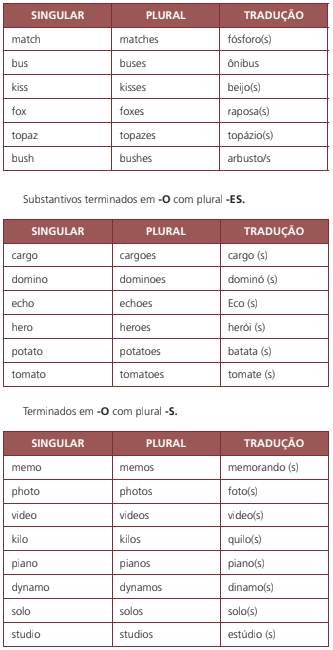
Substantivos terminados em -Y, precedidos de consoante, perdem o -Y e acrescenta-se -IES para formar o plural.

Substantivos terminados em -Y, precedidos de vogal, acrescenta-se -S para formar o plural.

Observação
Os substantivos dwarf (anão), scarf (cachecol), wharf (cais), hoof (casco), handkerchief (lenço) e scarf (cachecol) podem formar o plural tanto pelo acréscimo de -VES, como acrescentando apenas -S (regra geral).
Exemplos:
dwarf- dwarves/dwarfs
scarf- scarves/scarfs,
wharf- wharves/ wharfs
hoof -hooves/hoofs
handkerchief- handkerchieves/ handkerchiefs
scarf- scarves/ scarfs
Os demais substantivos terminados em -F, -FE ou –FF seguem a regra geral para formar plural, acrescentando apenas –S.


Substantivos incontáveis apresentam apenas forma de singular, logo concorda com o verbo no singular.


Exemplo:
The ethics is important in the world business.
Alguns substantivos são tipicamente utilizados apenas no plural, concorda com o verbo no plural.


Exemplo:
The pants are in the laundry.
Observação
A palavra “people” só vai para o plural com –S quando se referir a povo(s)
Exemplo:
The native peoples of Philippines and their problems.
ADJECTIVES (ADJETIVOS)
Os adjetivos em inglês são usados geralmente antes dos substantivos.
Exemplo:
wrong place, big house, small room, nice girl, tall man, thin boys, black cars
Alguns dos principais sufixos que formam adjetivos:
• Y
Exemplos:
healthy, cloudy, hungry, dirty, easy, funny, noisy, lucky
• LY
Exemplos:
brotherly, cowardly, fatherly, leisurely, friendly, monthly, lively
• LIKE
Exemplos:
businesslike, childlike, godlike, lifelike, workmanlike
• ISH
Exemplos:
childish, Spanish, foolish, reddish, Danish, snobbish
• FUL
Exemplos:
beautiful, shameful, careful, skillful, doubtful, useful, wonderful, harmful, hopeful
• LESS
Exemplos:
aimless, meaningless, careless, pointless, useless, hopeless, lifeless
• ABLE
Exemplos:
acceptable, considerable, eatable, readable, recognizable, respectable, believable
• IVE
Exemplos:
administrative, explosive, intensive, possessive, destructive, progressive
• ING
Exemplos:
daring, shocking, exciting, charming, boring, understanding
• ED
Exemplos:
disappointed, embarrassed, worried, satis ed, fascinated, reserved
Prefixos mais comuns:


TEXT COMPREHENSION

- (AFA) According to the cartoon, FIFA
a) pretends to improve the world.
b) mustn’t be considered an empire.
c) wants to have control over the Roman, Genghis Khan’s, and
British Empires.
d) has more ambitious purposes than the others.
TEXT 2
TITANIC – THE MOVIE
Storyline
In this ction movie, 84 years later, a 100-year-old woman named Rose DeWitt Bukater tells the story to her granddaughter Lizzy Calvert and others about her life set on April 10th 1912, on a ship called
Titanic when young Rose boards the departing ship with the upper-class passengers, her mother Ruth DeWitt Bukater, and her ancé. Meanwhile, a drifter and artist named Jack Dawson and his best friend
Fabrizio De Rossi win third-class tickets to the ship in a game. She explains the whole story from departure until the death of Titanic on its first and last voyage.
April 15th, 1912 at 2:20 in the morning.
Adapted from http://www.imdb.com/title/tt0120338/
TEXT 3
“My Heart Will Go On” is the love theme of the 1997 blockbuster lm Titanic. It was recorded by Celine Dion. Originally released in 1997, it went to number 1 all over the world. It became Dion’s biggest hit, and one of the best selling of all time, and was the world’s best-selling single of 1998.
Adapted from Wikipedia
TEXT 4
MY HEART WILL GO ON
(Celine Dion)
Soundtrack of Titanic
Every night in my dreams
I see you, I feel you,
That is how I know you go on
Far across the distance
And spaces between us
You have come to show you go on
Near, far, wherever you are
I believe that the heart does go on
Once more you open the door
And you’re here in my heart
And my heart will go on and on
[…]
Disponível em: http://www.stlyrics.com/lyrics/titanic/myheartwillgoon
- (AFA) After reading both Titanic storyline and soundtrack, we can
conclude that
a) Rose and Jack promised each other to be together.
b) the couple was sure their love wouldn’t last forever.
c) Rose and Jack boarded the same ship.
d) Rose knew their dreams would come true. - (AFA) Rose DeWitt Bukater is the
a) narrator.
b) protagonist of the real Titanic tragedy.
c) actress that starred this blockbuster.
d) inspiration for Celine Dion theme song. - (AFA) In the 2nd verse of the last strophe the word “does”
a) is only used as an auxiliary verb of a present tense.
b) reinforces the word before it.
c) emphasizes the verb after it.
d) has the same meaning as the verb ‘to make’.